

3 Ways the 2026 Tucson Lineup Outpaces the Ford Escape in Alberta
3 Ways the 2026 Tucson Lineup Outpaces the Ford Escape in Alberta
Posted on June 30, 2026
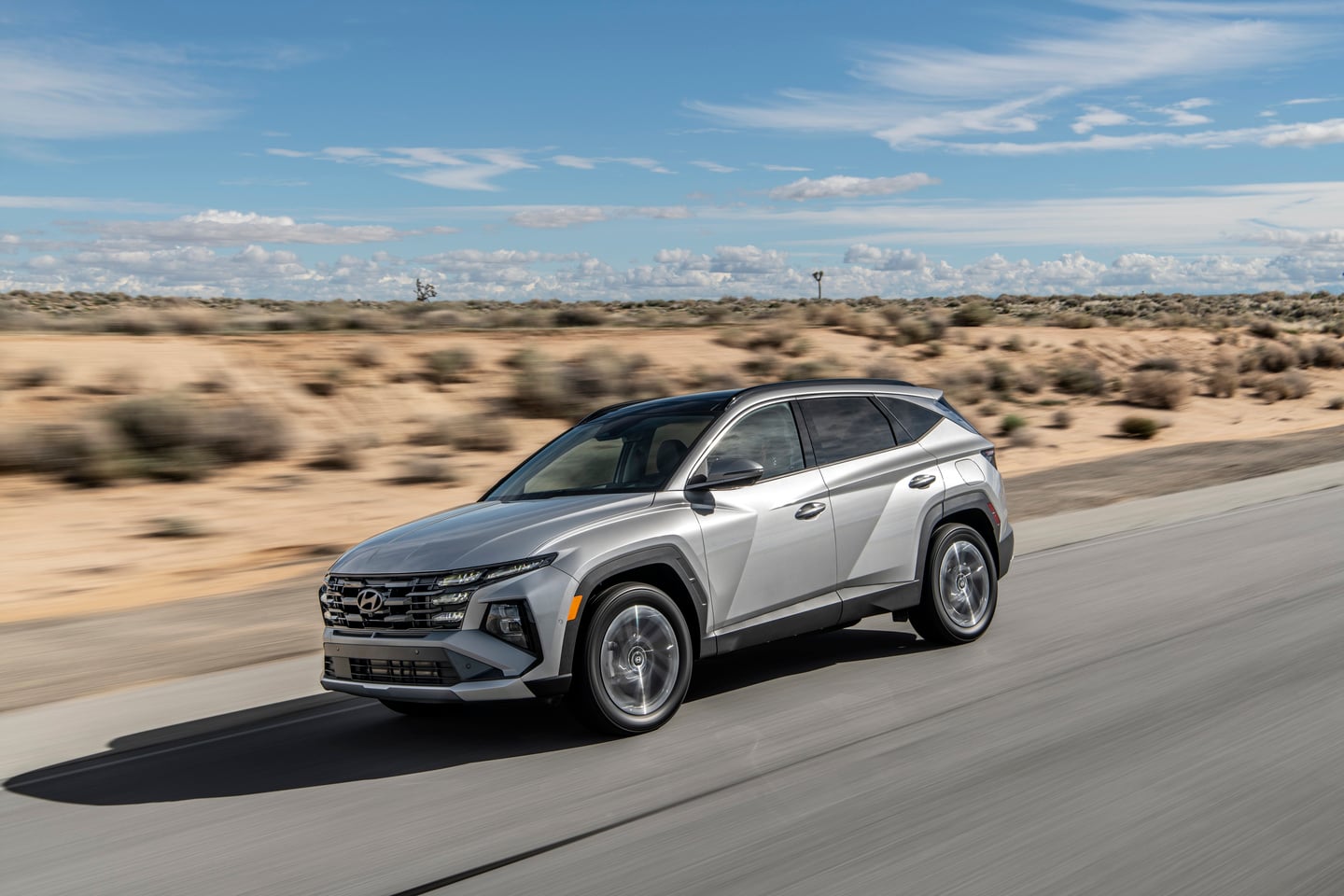
Two compact SUVs, same price bracket, five passengers each. The 2026 Hyundai Tucson and Ford Escape look similar on paper until you check the drivetrain column. The Tucson enters with AWD already included on every trim. For Alberta shoppers who would otherwise pay to upgrade just to get traction, that one fact reshapes the entire shortlist.
2026 Tucson vs. Ford Escape: Side-by-Side
| 2026 Hyundai Tucson | Ford Escape | |
| AWD | Standard - every trim | Optional; base Active trim is FWD |
| Ground clearance | 210 mm | 190 mm |
| Cargo, rear seats up | 1,095 L (2.5L) | 949 L |
| Cargo, seats folded | 2,119 L (2.5L) | 1,851.9 L |
| Peak system output | 268 hp (PHEV) | 250 hp |
| PHEV electric range | 51 km | 60 km |
| Powertrain warranty | 5 yr / 100,000 km | 5 yr / 100,000 km |
AWD Standard, Ground Clearance Up
HTRAC AWD is standard on every 2026 Tucson, from the base Preferred to the N Line hybrid and Ultimate PHEV. There is no FWD Tucson to accidentally end up in. The Escape’s entry-level Active trim ships with front-wheel drive; AWD appears on higher trims such as the ST-Line Select. A base-to-base comparison is AWD versus FWD, not a level playing field.
Ground clearance reinforces that gap. The Tucson sits at 210 mm; the Escape comes in at 190 mm. That 20 mm advantage adds real clearance over packed snow and uneven surfaces.
Snow, Mud, and Sand drive modes are standard on all five Tucson trims, across every powertrain, at no extra cost.
Three Powertrain Families
The Tucson offers three distinct routes:
- Preferred / Trend / XRT: 2.5L Smartstream four-cylinder, 187 hp, 178 lb-ft, 8-speed automatic, 8.8 L/100 km combined. Gas towing capacity: 3,500 lbs (1,588 kg) with trailer brakes.
- N Line: 1.6L turbo hybrid (HEV), 231 hp combined, 271 lb-ft combined, 6-speed hybrid automatic, flat 6.7 L/100 km city and highway.
- Ultimate: 1.6L turbo HEV standard or 1.6L turbo PHEV optional (268 hp combined, 271 lb-ft, 51 km all-electric range, 7.2 kW onboard charger).
The Escape’s gas lineup includes a 1.5L three-cylinder at 180 hp and a 2.0L four-cylinder at 250 hp, plus hybrid and PHEV variants. The Escape PHEV delivers 60 km of electric range, 9 km more than the Tucson PHEV’s 51 km. For a driver whose daily round trip falls almost entirely within electric range, that extra distance is a real number.
The Tucson PHEV still covers the vast majority of Alberta commutes on electricity, and its AWD is included rather than a separate line item.
The Tucson HEV’s 6.7 L/100 km flat rate, identical city and highway, keeps fuel budgeting simple whatever your mix of driving.
More Space, More Usable Cargo
With rear seats in place, the Tucson 2.5L carries 1,095 L of cargo. The Escape manages 949 L. Fold everything flat and the Tucson reaches 2,119 L against the Escape’s 1,851.9 L.
That 146 L advantage with seats up is roughly the volume of a large hockey bag. For families loading up gear, the extra room in the Tucson gets used on every trip, not just the occasional one.
Trim Walk: What Each Tucson Level Delivers
The Preferred is the starting point: AWD, 187 hp, heated front seats, heated steering wheel, dual-zone climate control, adaptive cruise control with stop-and-go, and wireless Apple CarPlay and Android Auto. Its 4.2-inch cluster display is the one area the Trend Package addresses immediately, stepping that up to a 12.3-inch digital cluster and adding a panoramic sunroof and wireless charging pad.
The XRT keeps the 2.5L engine and layers on a Bose 8-speaker audio system, electrochromic mirror, and XRT-exclusive 18-inch alloy wheels. The N Line is the hybrid entry point: 231 hp combined, N Line-exclusive suede-and-leather seating, 19-inch alloys, red interior stitching, and sport-tuned exterior trim. The Ultimate tops the lineup with the optional 268 hp PHEV, leather seating with ventilation, a head-up display, navigation, memory seating, and heated rear seats.
Which One Is Right for You?
For most Alberta compact SUV shoppers, the Tucson is the stronger choice at every trim level. AWD is already there at entry, so the money saved on an AWD upgrade stretches further into features instead. The taller ground clearance, larger cargo hold, and three powertrain families, from a capable gas AWD to a plug-in hybrid, give you a decision based on how you drive rather than what the base package excludes.
The Escape PHEV’s 60 km electric range lands in the Escape’s column. That single spec matters if all-electric daily range is your deciding factor. For the rest of the purchase criteria, AWD availability, cargo volume, ground clearance, and powertrain choice, the Tucson holds the stronger position across the board.
Find Your 2026 Tucson at Grande Prairie Hyundai
The 2026 Tucson pairs standard AWD with three powertrain choices and cargo capacity that leads this comparison, without asking you to upgrade to get the drivetrain Alberta roads require.
Visit Grande Prairie Hyundai in Grande Prairie to schedule a test drive and explore the Tucson trim that fits your daily drive.